
JSAD’s Conference Presence and Community Engagement
Over the past year, the Journal of Studies on Alcohol and Drugs (JSAD) has maintained a strong presence at major conferences across psychology, public health, and addiction science, including at the annual meetings of Collaborative Perspectives on Addictions (CPA), the Association for Psychological Science (APS), the College on Problems of Drug Dependence (CPDD), the Research Society on Alcohol (RSA), and the American Public Health Association (APHA). Attending these conferences as an exhibitor remains a cornerstone of how JSAD connects with researchers, authors, and students at every career stage.
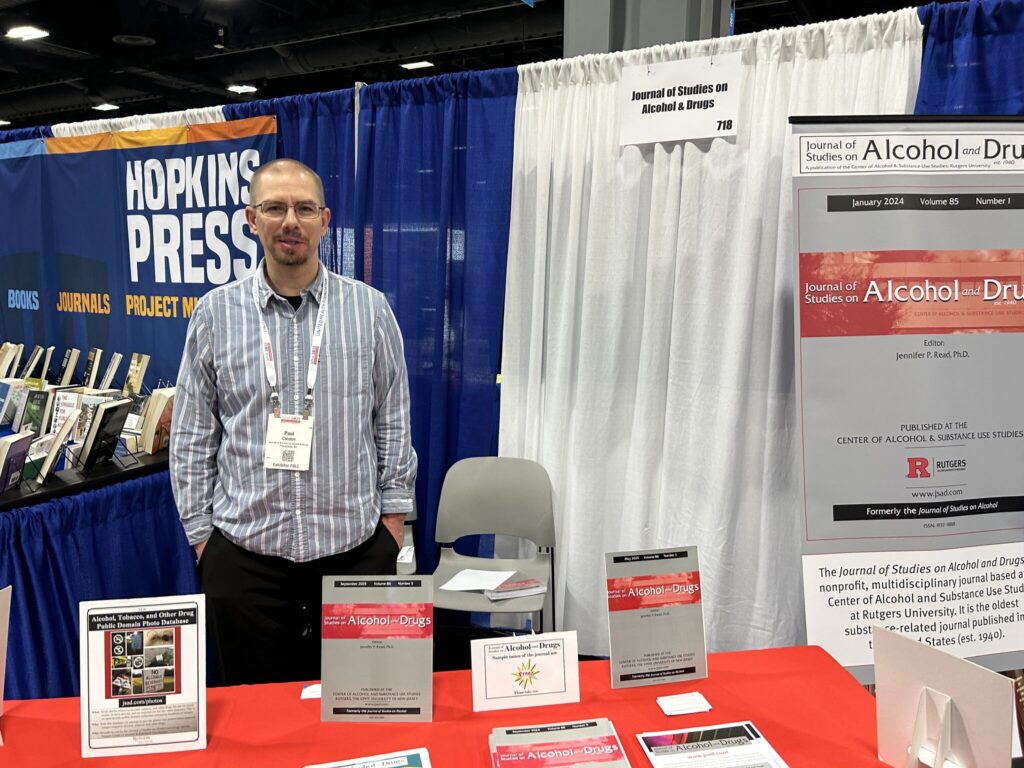
We recently spoke with Paul Candon, JSAD’s Editorial Director, about why conference attendance continues to be an essential part of the journal’s outreach and how in-person conversations help strengthen the journal’s relationship with the field.
Putting a Face to the Journal
One of the most valuable aspects of attending conferences is the opportunity to demystify the publishing process. As Candon explains, “Too often, publishing is a ‘black-box’ process, where authors don’t know who’s working on their article, what’s happening with their paper, or what the timeline is.”
Meeting journal staff face-to-face helps change that dynamic. Candon noted that many conference attendees, particularly at APHA, shared that they had never met someone from a journal in person before. “I think authors feel more comfortable submitting their research to a journal when they personally know the people who work there and know that they could reach out at any time and get a response quickly,” he said.
Making the Journal Tangible
Conferences also provide an opportunity to share the journal in very literal ways. JSAD brings free print copies to distribute at conference booths, something that often resonates with early-career researchers. “Quite a few younger researchers told me they’d never actually seen a hard copy of a journal,” Candon said. For many, it’s their first physical connection to an academic publication they may later read, cite, or submit to.
Questions from Authors and Our Scope
A question JSAD staff hear again and again at conferences is, “Does your journal publish research on…?” According to Candon, the answer is almost always yes.
“As a multidisciplinary journal, we’re always interested in good submissions on any aspect of alcohol or other drugs, from genetics to tax policy, and everything in between,” he said. This broad scope distinguishes JSAD from other addiction journals with a narrower focus, and conferences offer an ideal setting to make that clear to potential authors.
Beyond the Journal Pages
Conference conversations also help raise awareness of JSAD’s additional, free resources. Many attendees are excited to learn about projects such as the JSAD alcohol, tobacco, and other drug photo database and the journal’s blog, JSAD FastTakes. “Not everyone is aware of these,” Candon noted, “and people are often very excited to find that we have these extra resources.”
A Standout Year at APHA
Among this year’s meetings, the APHA conference stood out as a particularly meaningful experience. “APHA this year was one of the best conferences I’ve been to,” Candon said. “We had a good location for the booth and a lot of activity.”
Beyond steady foot traffic, the meeting provided opportunities for deeper engagement. Candon connected with researchers during poster sessions and spent time meeting with members of APHA’s Alcohol, Tobacco, and Other Drugs Section. “Most of all, I met with a number of section members, and we were all very interested in finding ways that we can work together more closely in the future,” he said.
Looking Ahead
JSAD plans its conference participation years in advance. The journal maintains a consistent presence at RSA and CPDD, which Candon describes as core meetings for the journal’s audience, while also attending about two conferences that are hosted on the East Coast each year.
Just as importantly, conferences allow JSAD to connect with students and early career researchers who are new to the field. “Every year, there’s a group of students that are new to field that we need to introduce ourselves to,” Candon said. “Today’s graduate students are tomorrow’s mid-career researchers. In 20 or 25 years, the journal may have an editor who is a student right now.”
By continuing to show up, listen, and engage, conferences remain an essential part of how JSAD supports the field, builds trust, and fosters lasting relationships across generations of researchers.