The Role of an Editorial Director: An Interview with Paul Candon, MA, CMPP
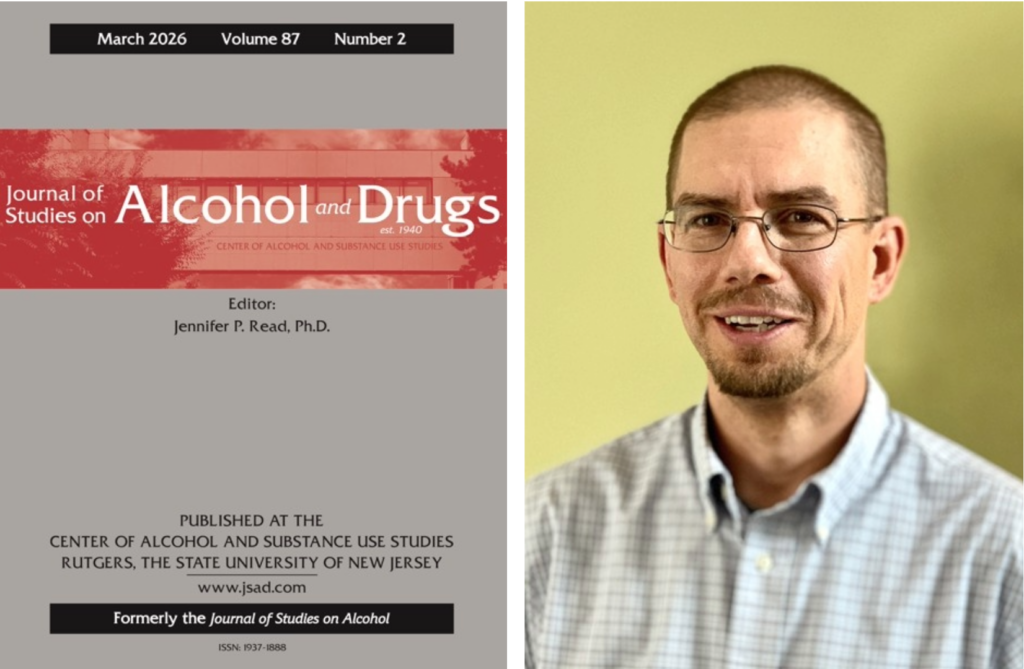
In this interview, Center of Alcohol & Substance Use Studies Postdoctoral Research Fellow, Emmanuel D. Thomas, PhD, sits down with the Journal of Studies on Alcohol and Drugs (JSAD) Editorial Director, Paul Candon, MA, CMPP, to explore the role of an Editorial Director, adapting to a changing publishing landscape, and supporting authors and reviewers.
Paul Candon, MA, CMPP | Center of Alcohol & Substance Use Studies
Emmanuel: Can you begin by telling us about your current role and how you came to serve as Editorial Director?
Paul: After grad school, I did a lot of medical editing, and I worked for a Johns Hopkins publication for a while. And I had done alcohol research, too, as a grad student when I was working on a master’s in psychology. The job at the journal combined a lot of the things that I had already been doing, with my background with alcohol research and editing, and it just seemed like a completely logical fit. I was just oddly qualified in a way that I wouldn’t have been for any other position.
Emmanuel: For readers who may not be familiar with journal operations, how would you describe the role of an Editorial Director?
Paul: Editorial director is a little bit of everything. It’s different from the role of editor-in-chief—not evaluating the science per se, but it’s everything else that happens around that. It’s part business manager, part production manager, part budget manager, part evaluating our performance and seeing what’s working and what’s not so that I can help inform decisions we make for the journal. There’s a lot to journal publishing that is more than what meets the eye. The thing that people think of when they think of a journal is there’s an editor and that person’s accepting or rejecting articles, but there’s this whole ecosystem behind that that has to be firing on all cylinders. And it’s not necessarily all forward facing or obvious when you just look at a journal website.
Emmanuel: When a research article is published, what happens behind the scenes that most authors and readers never see?
Paul: One thing that we have to do is really make sure that the research gets out to people. Back in the day before the internet, you printed up your journal, and then you put it in the mail, and then it got to the libraries, and people had to go find it there. And that was your big release of a journal issue. But now, even more than when we put the journal on the website, the email table of contents is like our big announcement that these articles are out now. If we just put them on the website, people would find them when they find them. I want to make sure that I’m putting stuff out there in a way that really is optimal. We do a press release for one article an issue too, so that one article will probably get a lot of attention. I feel that when that one article gets attention, it gets attention for the journal. And so that raises the cachet of everybody else who gets published. I want to make sure that the authors who trust us with their research are going to get the most exposure that they can.
Emmanuel: How does the role of an Editorial Director differ from that of an Editor-in-Chief?
Paul: The editor really is focused on the science. Our current editor is Jen Read, who’s been doing a great job for us since 2023. We get anywhere from 450 to 550 articles a year. And we publish anywhere from 20 to 25 percent of them. It’s a big responsibility to decide what to accept and what to reject. For authors, it’s a big deal whether you get published and how fast you get published or if you’re going to get rejected and have to go to another journal. So that’s her job. She’s not responsible for other issues like subscribers, budget, and what we have to do regarding the website. Those things fall more on me. I’ll give her information that will help inform her decisions, but the science decisions are hers.
Emmanuel: What does an average week look like for you in this position?
Paul: It could be anything, from week to week. One week might be more focused on journal issues, getting articles edited and produced and out. One week might be more budget focused. Another week might be getting ready for a conference that we’re going to exhibit at and making sure that we have everything lined up for that. Another week might be more focused on updates to the website. Random things come up all the time. There’s no monotony here. That’s for sure. It’s constantly changing, and things come up all the time that we just didn’t anticipate that have to be addressed right away. A big part of the job, too, is communicating with authors, making sure that they know that there’s a person at the other end of the line.
Emmanuel: What are the most complex or demanding aspects of overseeing a peer-reviewed journal? What are the most rewarding?
Paul: I think the most complex part of it is that there’s no one specific workflow or way to address all the competing issues at once. There’s stuff coming at all directions at one time, and you have to prioritize and figure out what’s the most important to get done today to push the journal forward, literally and figuratively.
The most rewarding is when we see the research we publish that gets out and makes a difference. For example, back in July of 2024, we published an article by Tim Stockwell and his colleagues. A general overview is that he reviewed a lot of the literature that initially said moderate drinking was going to be good for you because that had been the general zeitgeist. He went back and looked and said a lot of that research was flawed and that moderate drinking is not going to improve your health necessarily or lengthen your life. We’ve been around 87 years, and that by far is the biggest article on our website even though it’s only been out a year and a half. We promoted that because we thought this was important to get out there to the larger public. It asks a really big question: should you be drinking alcohol at all? It changed the conversation about alcohol. There’s putting an article on the website and then there’s making sure it gets out there. One point of this work is to let people know what the research is to inform people’s decisions.
Emmanuel: What skills or experiences are most essential for someone in your role?
Paul: It’s not a skill, but it’s more of an attitude: be willing to adapt. There’s been nothing static about this job. When I started, they hired me to be essentially a production manager—take the articles, get them copy edited, get them laid out, get them proofread, get the journal out. And then, “Oh, by the way we need a new website. We need to rework our peer review system. And we need to promote the journal and get more subscribers. And then we need a new open-access policy and need authors to not only know about it but utilize it.” So, I think that’s the one skill, if you can even call it a skill, is to just be willing to adapt. We can’t think that just because something worked two or five or 10 years ago that it’s going to work today or two, five, 10 years from now. There’s a core that’s always going to be the same: are we publishing good science? But how we achieve that is constantly changing.
Adapting to a Changing Publishing Landscape
Emmanuel: How has the role of an Editorial Director changed over the past decade, and how are digital publishing platforms reshaping editorial workflows and journal operations?
Paul: My role has changed from mainly trying to get journal issues out to being involved in decisions at every level really. We started on a Rutgers website, but the technology evolved to the point that we had to get a specialized vendor. We were involved in evaluating the vendors, transitioning thousands of articles from one website to the other, working with the people who code the articles for the websites. It’s those things that changed over time; not just getting a journal issue out but getting all types of new vendors to do different jobs to coordinate the whole process. We have a sales vendor that’s different from the people who order the subscriptions, that’s different from people who run the public-facing website, that’s different from people who run the peer review website. The services we have to provide to authors and readers, and the number of vendors we use to manage those services, have increased over the years, and making sure that all those things are coordinated is really how it’s evolved.
I would say, oddly, I don’t think the workflow has changed very much, and the reason is that editing and producing an article for print versus online is actually not that different at all. A lot of times people will ask me, “Hey, why don’t you get rid of the print? It’s just, it’s unnecessarily expensive. No one really reads the print anymore,” but a number of subscribers still do. What I tell people is I’m doing all the same work anyway. It’s just that somewhere down the line, I’m telling someone to hit print and then they mail it out. There are certain things that are automated that maybe weren’t before. For example, back in the day we paid human beings to sit there and fact check reference lists, which sounds crazy, but then one day I discovered that there was a program that does that. There are programs that you can use that can really automate some of the processes. The flip side of it is that we still have a human being who sits there and proofreads everything before it goes out because at the end of the day, human beings are reading these and no matter how much we can automate the process, I still want to know that I’m putting something out there that has been vetted by a human being.
Emmanuel: Open access continues to generate debate across academic publishing. How do you see this shaping the future of scholarly journals?
Paul: Everyone agrees that a big goal of the science we’re all involved in is to make it as widely available as possible. But it’s how we get there; that’s the question. Despite open access being a big part of the conversation for over 20 years, no one has yet developed a business model that works for everyone. Even for us as a nonprofit, we still have costs—salary, websites, production costs, etc. And those are not insignificant. I wish I could say this is something that will be solved soon, but unfortunately, achieving open access in a way that authors and readers are happy with is something that will likely continue to vex science for a long time.
Emmanuel: Many journals are experiencing increased submission volumes. How does that affect editorial decision-making and infrastructure?
Paul: We’re always happy to see the journal grow, and increased submissions are part of that. We’ve seen a marked increase in the last year, which is great. The challenge is that we have only a certain amount of space and resources to publish a certain amount of research. The good news is that there are more substance use journals every year, so there are more options for authors, too.
Emmanuel: AI tools are increasingly being used in manuscript preparation and review. How are advances in technology, including AI, reshaping editorial processes?
Paul: We do ask authors to disclose any use of AI and require that they not use AI to generate original text. But there is no foolproof way of identifying AI-generated language. So, it puts a greater onus on reviewers and field editors to be more scrutinizing. We now specifically require that reviewers not use AI for their reviews. Not only do we want human review, but there are privacy concerns with loading someone else’s manuscript into an AI platform.
Supporting Authors and Reviewers
Emmanuel: Building strong relationships with authors and reviewers is essential to a journal’s success. What are some of your approaches?
Paul: For better or worse, email is the main interaction between the journal and our authors and reviewers. One thing we try to make sure of is that, even in emails auto-generated from our peer-review system, we’re writing in a way that is respectful of authors’ and reviewers’ time and involvement. It sounds almost too simple, but if you get an email just barking a list of instructions, your reaction is way different than if you get a human message that’s respectful. Little things like that can make a difference. Always responding in a timely manner is important too. No author wants to feel like their manuscript disappeared into a black box. For reviewers, we try to be respectful of their time and not burden them with too many requests in a short period.
Emmanuel: What advice do you typically give first-time authors preparing to submit their research?
Paul: Follow the journals’ instructions in their author guidelines pretty carefully. Although some requirements may seem arbitrary from journal to journal, you never know what is really important to that publication. You don’t want to get your manuscript kicked back to you and to waste your own time for small things that can be fixed before submission.
Also, research the journal pretty well before you submit. Is it a good fit? Are you being too ambitious? Not giving yourself enough credit? Is your topic something they publish on often? Have colleagues published there and had a good experience? Once you submit your article, you’re more or less locked in until they accept or reject. So, it pays to do some investigation first.
Emmanuel: How do you cultivate and retain strong peer reviewers?
Paul: I think part of it begins with our reputation and that we are appreciative of our peer reviewers in all our communication with them. Without peer reviewers, science doesn’t move forward. We also publish a list of our reviewers every year, not only to thank them but also to publicly acknowledge their work. This year, we also sent gift cards to our top few ad hoc reviewers to let them know how much we value them.
Emmanuel: How do you balance reducing barriers for authors, particularly early-career investigators, while maintaining scientific rigor and quality standards?
Paul: I think you can have a great idea and do great work at any point in your career. So, what I think our editorial staff are really focused on is the quality of the science and how much ideas and research move the field forward rather than just where someone is in the career. If you’re young and doing good work, that tends to come through.
Emmanuel: What do you think authors and reviewers often misunderstand about the editorial process?
Paul: I think the biggest misperception about journal publishing overall is that we just put a pdf online. There is a whole infrastructure behind the scenes to make sure that articles are reviewed, edited, and discoverable so that we do right by our authors as much as possible. It’s a process that does require an investment of time and resources, whether you’re at a nonprofit or a large publisher. We’re putting an article into the scientific literature in perpetuity, and we need to have a stable business to do that as well.
Closing
Emmanuel: What makes JSAD unique operationally compared to other peer-reviewed journals?
Paul: As a university-based, nonprofit title, we don’t have the overhead and bureaucracy that some other publications might have. So, we’re able to make decisions, adapt, and effect change quickly. It also means we have a small staff that’s available to be responsive to authors and reviewers.
Emmanuel: What is your vision for strengthening the journal’s editorial infrastructure in the coming years?
Paul: There are some organizations in the field we’re hoping to partner with, although I can’t reveal anything specific yet. But I’m not content to just sit back and say, “We’ve been around 87 years, so we’re good.” We have to constantly look for ways to be relevant and improve. And improving our connections in the field to the people and institutions who are doing good work is something we’re looking to expand on.
Emmanuel: Finally, why does this work matter—for you personally and for the broader addiction field?
Paul: I can’t tell you how many people I know whose lives have been upended by substance use. I’ve lost some people very close to me. So, this isn’t an academic exercise for me. I know that the field moves slow, sometimes too slow, but I also know that good research and investigators who think big have the opportunity to directly save people’s lives. That’s the type of research I want to help get out into the world.